
Every community has a responsibility to plan for its future. For Fuquay-Varina, that includes securing a reliable long-term water supply for the residents, businesses and public services that depend on it.
After more than five years of study and public review, the Town is seeking approval of a 6.17 million gallon per day Interbasin Transfer (IBT) from the Cape Fear River Basin to the Neuse River Basin. The request is based on projected water needs through 2055 and will help ensure the Town has the water resources needed to support its growing community for decades to come.
The application before the Environmental Management Commission is supported by a detailed Environmental Impact Statement, extensive technical analysis and one of the most comprehensive public review processes required under North Carolina law.
Request at a Glance
Applicant: Town of Fuquay-Varina
Requested Transfer: 6.17 MGD
Source Basin: Cape Fear River Basin
Receiving Basin: Neuse River Basin
Water Source: TriRiver Water / City of Sanford
Earliest Transfer: 2035
Two Things to Know
The Need Is Real
Fuquay-Varina has long relied on wholesale water purchased from neighboring utilities. Those partnerships have served the Town well but cannot continue to meet projected water needs through 2055.
Planning for future water needs requires years of engineering, permitting and investment. Communities cannot wait until additional capacity is needed before beginning that work.
The Science Supports It
The Environmental Impact Statement evaluates 16 alternatives using nearly 100 years of hydrologic data, including multiple historic droughts and three climate scenarios.
The study found the proposed transfer will not adversely affect water quantity, water quality or ecological health in the Cape Fear River Basin.
The Facts
5+
Years of Study
16
Alternatives Evaluated
~100
Years of Data Analyzed
<0.3%
Impact on Average River Flow
The Request in Context
At 6.17 million gallons per day, Fuquay-Varina’s request is the smallest interbasin transfer proposed under North Carolina’s current IBT law.
The requested transfer represents less than 0.3 percent of the Cape Fear River’s average flow. Studies show that even during a Level 1 drought, the transfer will have almost no measurable impact on downstream water levels.
Comparison of North Carolina Interbasin Transfers (MGD)
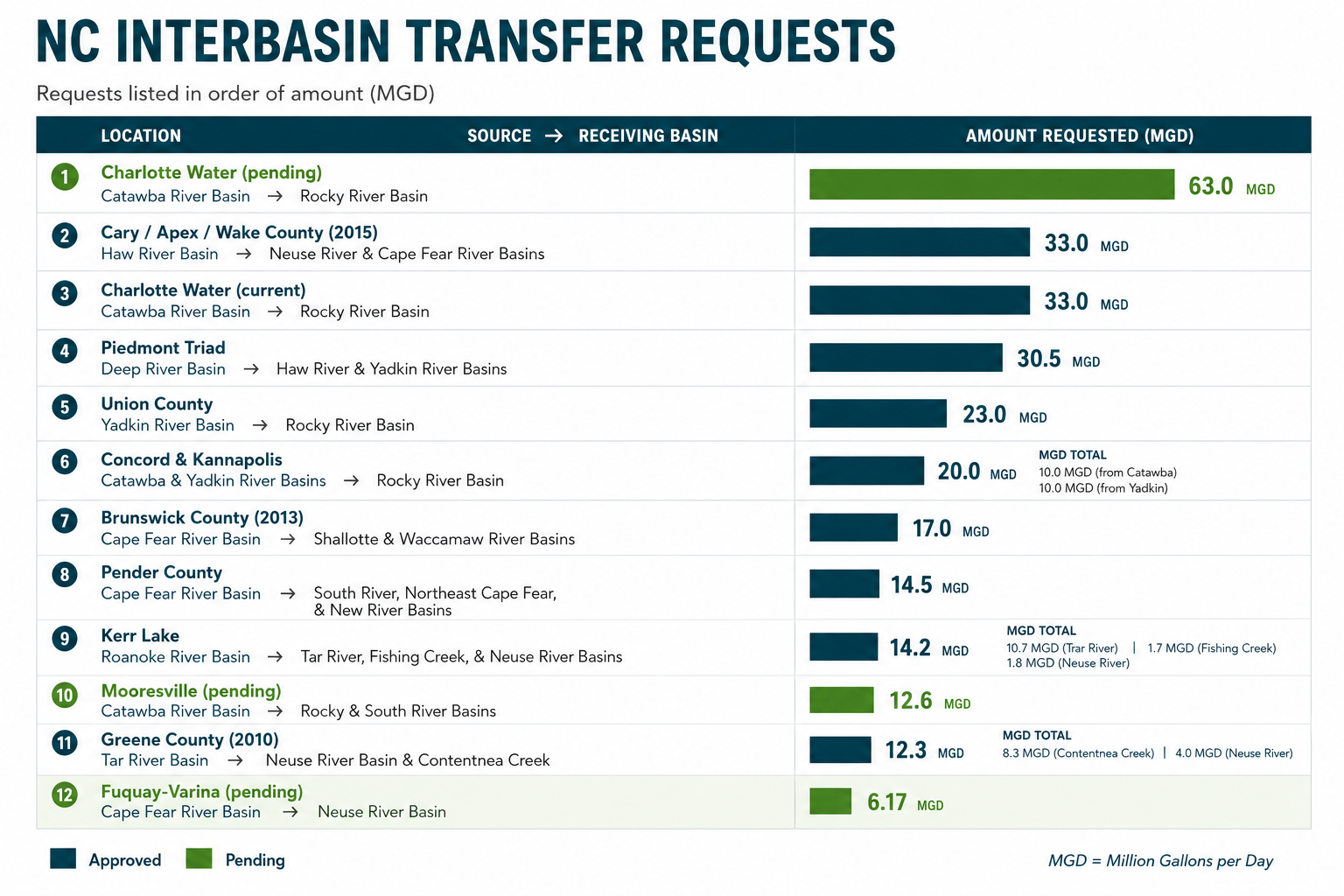
All values in million gallons per day (MGD). Chart scaled to Charlotte Water’s pending 63 MGD request.
The Process Worked
North Carolina established the interbasin transfer process to ensure decisions like this are informed by science, public input and careful regulatory review.
Since filing its Notice of Intent in 2020, Fuquay-Varina has completed every step required under state law, including preparation of an Environmental Impact Statement, technical review, public hearings and an extended public comment period.
The application is now before the Environmental Management Commission with a complete factual record developed through that process.

Why This Matters
Water systems are built for generations, not just today’s needs. Planning for future demand requires communities to act years before additional capacity is needed.
The Environmental Management Commission’s role is to determine whether this request satisfies the standards established under North Carolina law. The Town believes the record developed through the IBT review process demonstrates that it does.