
What the Environmental Impact Statement Found
The central question before the Environmental Management Commission is straightforward: What effect would the proposed transfer have on the Cape Fear River Basin?
North Carolina law requires communities seeking an interbasin transfer to prepare an Environmental Impact Statement (EIS) evaluating the potential effects of the proposed transfer on both the source and receiving river basins.
The study reached a consistent conclusion: The proposed interbasin transfer will not adversely affect water quantity, water quality or ecological health in the Cape Fear River Basin.
Environmental Analysis at a Glance
5+
Years of Study
16
Alternatives Evaluated
3
Climate Scenarios
2055
Planning Horizon
River Flow
One of the primary questions addressed in the Environmental Impact Statement is how the proposed transfer would affect flows within the Cape Fear River.
The study evaluated river conditions at multiple locations under average flows, median flows and severe drought conditions.
Under average conditions, the requested transfer represents less than 0.3 percent of river flow.
Even during the driest one percent of historical conditions, the modeled changes remain small and do not alter downstream drought-response thresholds.
Modeled Change in River Flow
| River Condition | Lillington (Upstream) | Tarheel Gauge (Mid) | Lock & Dam #1 (Near Fayetteville) |
|---|---|---|---|
| Average flow conditions | 0.31% | 0.21% | 0.19% |
| Median flow conditions | 0.87% | 0.44% | 0.38% |
| Driest 1% of historical conditions * | 3.2% | 1.8% | 1.7% |
* “Driest 1%” represents the most extreme drought conditions in 97 years of historical record, more severe than any drought experienced in living memory. Even at this extreme, the transfer does not cross any downstream drought-response threshold.
Figures drawn from the Draft Environmental Impact Statement, Town of Fuquay-Varina IBT (October 2025).
Water Quality
River flow is only one measure of environmental impact. The Environmental Impact Statement also examined whether the proposed transfer would affect water quality within the Cape Fear River Basin.
Based on the modeled changes in river flow, the study found the proposed transfer would not affect water quality or require changes to downstream wastewater permitting assumptions.
It also found the transfer would not increase the potential for impacts to aquatic resources associated with reduced river flow.
Climate Conditions
Historical records provide the foundation for understanding river conditions, but they are only part of the analysis.
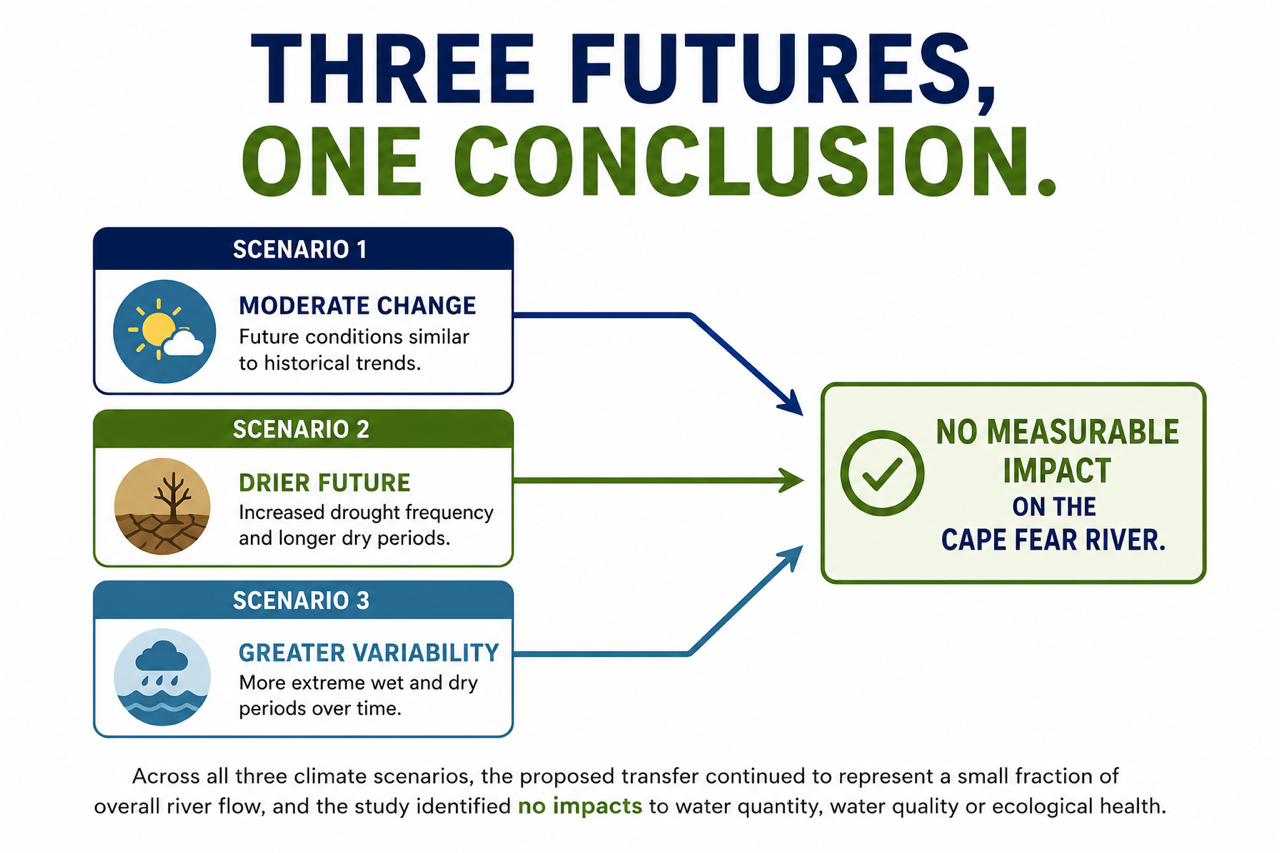
The Environmental Impact Statement also evaluated three climate scenarios representing a range of future conditions, including increased drought frequency and greater hydrologic variability.
Across all three scenarios, the results remained consistent. The proposed transfer continued to represent a small fraction of overall river flow, and the study identified no impacts to water quantity, water quality or ecological health.
Cumulative Impacts
The Environmental Impact Statement evaluated more than Fuquay-Varina’s request alone.
Its hydrologic model incorporates projected future water demands throughout both river basins using published Local Water Supply Plans. That approach allows the proposed transfer to be evaluated within the broader context of projected regional water use over the planning horizon.
Downstream Water Supplies
Potential effects on downstream water supplies were a central part of the Environmental Impact Statement.
At the Fayetteville Public Works Commission intake, the modeled change during Drought Level 1 conditions is less than two millimeters of river stage. According to the study, that change does not alter downstream drought-response thresholds.
The requested transfer also reflects projected demand at the end of the planning horizon. Water use would increase gradually over time, with the earliest withdrawals anticipated around 2035.

The Bottom Line
The Environmental Impact Statement evaluated the proposed transfer from multiple perspectives, including river flow, water quality, ecological health, future climate conditions and cumulative regional demand.
Across each area of analysis, the findings remained consistent.
The study found the proposed transfer would not adversely affect water quantity, water quality or ecological health in the Cape Fear River Basin.